
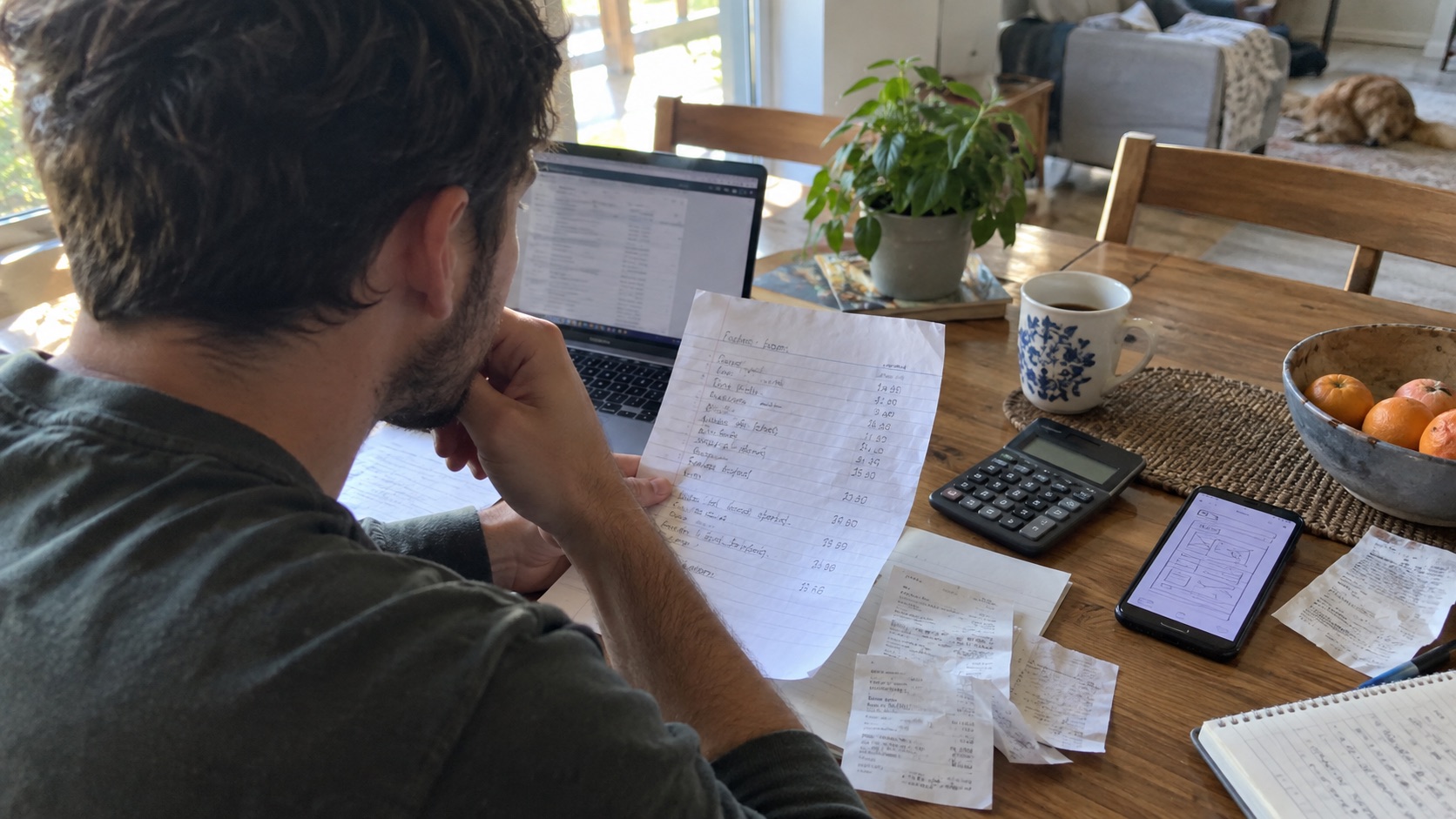
App development can cost a monthly software subscription, a few thousand dollars for a focused prototype, or hundreds of thousands for a complex product. The useful answer begins with scope: what must work, for whom, on which platforms, with which operational and compliance requirements?
Published 2026 market guides illustrate the spread. Zoho’s current overview cites approximately $15,000 to $40,000 for simple commissioned apps, $40,000 to $120,000 for medium complexity, and $100,000 to $250,000 or more for complex builds. These are broad market estimates, not a quote for your product. AI, no-code, an internal team, geography, and reusable foundations can produce very different numbers. Review the underlying cost guide and methodology before using the ranges in a budget.
The basic cost model
A services estimate usually follows:
Required effort × blended team rate + external costs + contingency = initial budget
Required effort includes discovery, design, implementation, review, testing, delivery, and project coordination. A fixed-price proposal still contains assumptions about those variables.
Cost by product stage
Prototype
A clickable or limited technical prototype answers a question. It may omit production infrastructure, account recovery, analytics, store preparation, and operational tooling. Its price should not be compared directly with a production application.
Focused MVP
A real MVP completes one core journey for a specific audience. It usually needs production data, authentication where relevant, error handling, analytics, support basics, testing, and deployment. Narrow scope makes it affordable, not lower quality in the core journey.
Established product
A growing app accumulates roles, billing states, integrations, migrations, admin workflows, accessibility obligations, observability, and support. Cost shifts from initial construction to reliable change.
Complex or regulated system
Specialized hardware, live media, offline synchronization, high scale, healthcare or financial controls, and multiple enterprise integrations require deeper engineering and evidence. Budget for security, compliance, operations, and failure recovery as product work.
The factors that move the estimate most
Scope and edge cases
“User profiles” can mean a name and photo or identity verification, privacy controls, moderation, export, deletion, blocking, and organization membership. Estimate behaviors and states, not feature labels.
Backend complexity
Data modeling, authorization, integrations, search, background work, and admin operations are often less visible than interface work but materially affect cost.
Platforms
A responsive web app, iOS app, Android app, and internal admin console are separate delivery surfaces even when they share logic. Cross-platform development can reduce duplication, but signing, store work, permissions, and device testing remain.
Team and delivery model
Freelancers, agencies, in-house teams, no-code tools, and AI builders price different things. Compare the complete deliverable: research, design, code, data, infrastructure, QA, store submission, documentation, and post-launch support.
Integrations
Payments, maps, identity providers, messaging, and external business systems introduce setup, policy, testing, and failure-handling work. An API being available does not make an integration free.
Quality and risk
Accessibility, security review, performance targets, audit trails, backups, and recovery are not polish. The required evidence increases with the consequence of failure.
Costs people forget
- Developer program and store accounts.
- Hosting, databases, storage, email, maps, and third-party APIs.
- Analytics, monitoring, support, and customer communication.
- Legal, privacy, security, and compliance work.
- Store creative, website content, acquisition, and localization.
- Dependency and operating-system updates.
- Fixes, experiments, and new requirements after launch.
What an AI app builder costs today
AI app builders replace most of the services cost model above with a monthly subscription plus usage. The numbers below were checked directly on each vendor's own pricing page today (September 24, 2026), and pricing changes often, so confirm current figures before budgeting.
GrowApps runs on two paid plans: Standard at $20 a month (20 credits) and Pro at $200 a month (300 credits), both with an annual option billed at ten months for twelve. Credits roll over for one month. A first build typically uses around 4 credits, so a Standard plan covers roughly five first builds a month before you spend the rest on iteration, fixes, and new features.
Two comparable AI builders, checked the same day:
- Base44: Starter plan from $16 a month. Source: base44.com/pricing.
- Replit: Core plan from $18 to $20 a month depending on billing. Source: replit.com/pricing.
These entry prices buy generation and iteration, not automatically store submission, a signed release build, or ongoing operations. Compare what each plan includes before choosing one on price alone: export terms, mobile output versus web only, and whether store-ready signing is part of the workflow or a separate step you own.
How to get a useful quote
Prepare a brief with the target user, core journey, roles, platforms, integrations, data sensitivity, design expectations, and launch constraints. Ask every supplier to separate assumptions, exclusions, third-party costs, and ongoing support.
Request a paid discovery phase when uncertainty is high. A smaller evidence-producing engagement is safer than forcing a precise fixed price onto an unclear product.
How to reduce cost without damaging the product
Narrow the audience and journey. Use a shared platform strategy when appropriate. Choose standard integrations. Delay speculative features. Test risky assumptions early. Reuse a mature design system. Keep decision-makers available so work does not idle or churn.
Do not save money by removing authorization checks, backups, accessibility, or testing from a product that depends on them.
Frequently asked questions
Can I build an app for under $10,000?
Yes for some prototypes, simple tools, template-led products, and self-service AI/no-code builds. A commissioned production app with custom behavior may exceed that quickly. Define what “built” includes.
Why are app quotes so different?
They may cover different scope, quality, team rates, ownership, platform count, and post-launch work. Compare line items and assumptions rather than totals alone.
How much should I reserve after launch?
There is no universal percentage. Model known infrastructure, support, maintenance, policy updates, and a change budget from your roadmap and risk. Treat launch as the start of operation.
If the first budget should focus on learning, read MVP app development and describe the core journey to GrowApps.